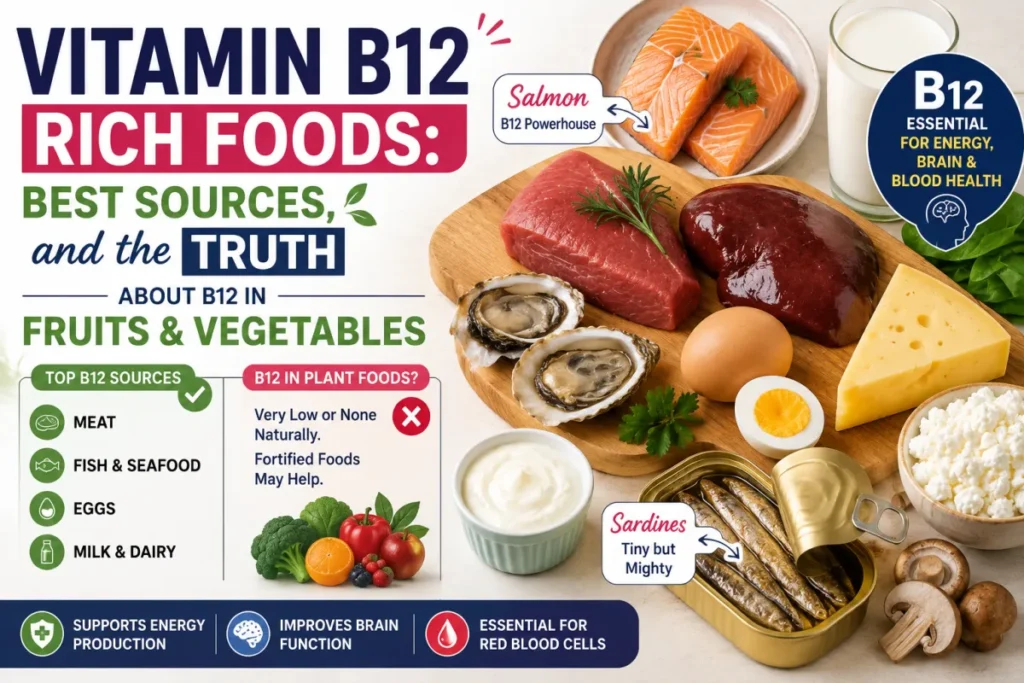
Vitamin B12 is one of those nutrients that the body needs in a small amount, but its role is very important. It helps keep nerve cells healthy, supports red blood cell formation and is also involved in making DNA. The recommended amount for most adults is about 2.4 micrograms (mcg) per day.
When people search for vitamin B12 rich foods, they often expect to find fruits, vegetables, nuts or seeds on the list. This is where a common misunderstanding starts. Unlike many other vitamins, vitamin B12 is not naturally present in ordinary fruits and vegetables. Natural B12 mainly comes from animal foods, while some plant-based foods contain B12 only because it has been added to them.
Vitamin B12 Rich Foods: An Overview
| Food Source | Approx. Vitamin B12 |
|---|---|
| Beef liver, 3 oz | 70.7 mcg |
| Clams, 3 oz | 17 mcg |
| Oysters, 3 oz | 14.9 mcg |
| Fortified nutritional yeast, ¼ cup | 8.3–24 mcg |
| Salmon, 3 oz | 2.6 mcg |
| Canned tuna, 3 oz | 2.5 mcg |
| Ground beef, 3 oz | 2.4 mcg |
| Milk, 1 cup | 1.3 mcg |
| Plain yogurt, 6 oz | 1.0 mcg |
| Egg, 1 large | 0.5 mcg |
The exact amount can vary depending on the food, brand and serving size. These figures are useful for understanding which foods can make a meaningful contribution to your daily B12 intake.
Why Vitamin B12 Is Important
Vitamin B12 has several important jobs in the body. It helps maintain healthy nerve cells and supports the production of red blood cells. It also plays a role in DNA production and normal cell metabolism.
A lack of B12 can eventually affect the blood and nervous system. However, symptoms are not always obvious at first. Some people may experience tiredness, weakness, pale skin or changes related to nerve function. If a deficiency is suspected, it is better to get appropriate testing and medical advice rather than simply taking large amounts of supplements.
Best Animal Sources of Vitamin B12
For people who eat animal products, getting B12 from food can be quite straightforward.
1. Liver
Beef liver is one of the richest natural food sources of vitamin B12. A small serving can provide many times the daily requirement. Because it is extremely rich in B12, liver does not need to be eaten every day to get this vitamin.
2. Fish and Seafood
Fish can be a practical source of B12. Salmon and tuna contain useful amounts, while shellfish such as clams and oysters can contain much higher levels. Seafood can therefore be a good option for people who want to increase B12 through regular meals.
3. Meat and Poultry
Beef, chicken and turkey provide B12 in different amounts. Beef is generally a stronger source than some types of poultry. Adding meat to a balanced diet can help provide B12 along with protein and other nutrients.
4. Milk and Dairy Products
Milk, yogurt and cheese are also sources of B12. For example, one cup of milk provides around 1.3 mcg, while a serving of plain yogurt provides about 1 mcg. Dairy can be especially convenient because it can easily be included in breakfast, snacks or everyday meals.
5. Eggs
Eggs contain vitamin B12, although the amount is not as high as in liver, seafood or meat. One large cooked egg provides around 0.5 mcg. Eggs can still contribute to daily intake when included regularly in a balanced diet.
Do Fruits Contain Vitamin B12?
This is one of the biggest questions about B12 nutrition.
Ordinary fruits do not naturally provide meaningful vitamin B12. Bananas, apples, oranges, mangoes, papaya, guava and other common fruits are healthy foods, but they should not be considered reliable sources of B12.
For example, nutrition data lists a medium banana as having essentially 0 mcg of B12. Strawberries also provide 0 mcg in the listed serving.
This does not mean fruits are unhealthy. Fruits provide fiber, vitamin C, folate, potassium and many other useful nutrients. The point is simply that B12 should not be counted on when eating fruit.
Do Vegetables Have Vitamin B12?
The same basic rule applies to vegetables. Regular vegetables do not naturally contain vitamin B12.
Spinach, broccoli, carrots, potatoes, peas and other vegetables can be excellent parts of a healthy diet, but they are not dependable B12 sources. Data for foods such as boiled spinach and kidney beans shows no natural B12 in the listed servings.
You may see online claims that certain vegetables, leafy greens or fermented plant foods contain B12. In many cases, these claims confuse B12 with other B vitamins or refer to compounds that are not reliable sources of active B12 for human nutrition.
What About Plant-Based Sources of B12?
There is an important exception: fortified foods.
Some plant-based products have vitamin B12 added during manufacturing. Fortified breakfast cereals and fortified nutritional yeast are common examples. The amount depends on the product, so checking the nutrition label is important.
This makes fortified foods particularly useful for vegetarians and vegans. Someone who avoids meat, fish, eggs and dairy cannot simply replace these foods with fruits and vegetables and expect to receive enough B12 naturally.
Some foods made from soy or other plants may also be fortified, but consumers should not assume that every plant-based product contains B12. Always check the label for added vitamin B12.
Vitamin B12 for Vegetarians and Vegans
People following vegetarian or vegan diets need to pay extra attention to B12. Vegetarians who eat dairy and eggs may get some B12 from these foods, while vegans need a dependable source from fortified foods or supplements.
Another important point is that getting enough B12 on paper does not always guarantee that the body will absorb enough. Certain stomach and intestinal conditions, some surgeries and other factors can interfere with B12 absorption. Older adults may also have more difficulty absorbing B12 naturally present in food.
If blood tests show a deficiency, a doctor may recommend an appropriate supplement or, in some cases, B12 injections.
How to Add More B12 to Your Daily Diet
For non-vegetarians, simple food choices can make a big difference. Milk with breakfast, yogurt as a snack, eggs, fish or meat with meals can all contribute to B12 intake.
For vegetarians and vegans, fortified foods can be included regularly. Fortified cereals and nutritional yeast can be useful options, but the amount of B12 varies considerably between products. Reading the nutrition label is therefore important.
There is no need to completely change your diet just because B12 is important. The better approach is to understand where the vitamin actually comes from and make sure your regular diet includes a reliable source.
Can You Get Enough B12 From Fruits and Vegetables Alone?
For most people, the answer is no. Fruits and vegetables are extremely important for overall health, but they do not provide a dependable natural source of B12.
This is especially important for people following plant-based diets. A diet can contain plenty of spinach, fruits, beans, lentils, nuts and whole grains and still be low in B12. In such cases, fortified foods or a suitable B12 supplement may be necessary.
Frequently Asked Questions
1. Which food is highest in vitamin B12?
Beef liver is among the richest natural food sources of B12. Seafood such as clams and oysters can also provide very large amounts.
2. Which fruits are rich in vitamin B12?
No ordinary fruit is a reliable natural source of vitamin B12. Fruits can be nutritious for many other reasons, but B12 should not be counted on from them.
3. Which vegetables contain vitamin B12?
Regular vegetables do not naturally provide reliable vitamin B12. If a plant-based product contains B12, it is usually because the vitamin has been added through fortification.
4. Can vegetarians get enough vitamin B12?
Yes, but the source matters. Vegetarians may obtain B12 from dairy products and eggs, while fortified foods or supplements can provide additional support when needed.
5. Do vegans need a vitamin B12 supplement?
Vegans need a reliable B12 source because unfortified plant foods do not naturally provide B12. This can come from appropriately fortified foods and/or a B12 supplement. People with suspected deficiency should discuss testing and supplementation with a healthcare professional.
Final Words
Vitamin B12 is a small but essential part of a healthy diet. The most important thing to remember is that natural B12 mainly comes from animal foods, including fish, seafood, meat, eggs and dairy. Fruits and vegetables are healthy, but they are not natural B12-rich foods.
For people following vegetarian or vegan diets, fortified foods and suitable supplements can help fill the gap. Rather than believing lists that claim bananas, spinach or other ordinary plant foods are rich in B12, it is better to check reliable nutrition information and food labels. With the right food choices and, when necessary, professional guidance, maintaining adequate B12 intake can be simple.